Last reviewed: October 2026
Spain’s healthcare system is excellent. Getting into it correctly is the part that takes planning.
That sentence summarizes the experience of almost every American family we have guided to Spain. Once people arrive, the quality of care is rarely their concern. The concern is the transition: which coverage the visa requires, when access to the public system becomes possible, what it costs, what it leaves out, and what happens to Medicare along the way. Each of these questions has a clear answer. The answers simply need to be gathered in the right order, and ideally many months before the move.
This guide to healthcare in Spain for Americans sets out that order. It is written for Americans relocating to Spain, particularly retirees and families applying for the Non-Lucrative Visa, and it reflects the questions we hear most often from the families we advise. Latin American families following the same visa pathway will find that everything here applies to them as well, with the exception of the section on Medicare.
First, a word on why the planning is worth the effort. Spain consistently earns international recognition for its health outcomes. In the 2019 edition of Bloomberg’s Healthiest Country Index, which ranked 169 economies, Spain placed first, while the United States placed 35th, as reported by TIME. Spain also has one of the highest life expectancies in the European Union. Newsweek’s World’s Best Hospitals 2026 ranking places Hospital Universitario La Paz, Hospital 12 de Octubre, and Hospital Gregorio Marañón in Madrid, together with Vall d’Hebron and Hospital Clínic in Barcelona, at the top of the country’s list. These are world class institutions within a public system that residents access for a fraction of what comparable care costs in the United States.
The opportunity is real. So is the process for reaching it.
Part I: How Healthcare in Spain Is Organized
Spain’s public healthcare system, the Sistema Nacional de Salud, is universal and funded primarily through taxation. Although it is a national system, it is managed by each of Spain’s seventeen autonomous communities, which means that your care will be administered by the regional health service where you live: the Servicio Madrileño de Salud in Madrid, CatSalut in Catalonia, the Servicio Andaluz de Salud in Andalusia, and so on. Access is granted through a personal health card, the tarjeta sanitaria individual, issued by that regional service.
The system is built around primary care. Each resident is assigned to a local health center (centro de salud) and a family doctor (médico de cabecera), who serves as the gateway to specialists, diagnostic tests, and hospital care. For most Americans, this is the first cultural adjustment: specialist care usually begins with a referral rather than a direct appointment.
Alongside the public system, Spain has a large and modern private healthcare sector. More than 14 million people in Spain held private health insurance by the end of September 2023, according to insurance industry data reported by El Independiente. Many Spanish families use both systems at once: the public system for serious, complex, and chronic care, where its hospitals are exceptional, and private insurance for faster access to specialists, elective procedures, and private hospital rooms.
That dual use reflects a reality worth understanding clearly. The public system’s principal weakness is waiting time for non-urgent care. In April 2026, Euronews reported that a record of more than 853,000 people were waiting for non-urgent surgery in Spain, with an average wait of 121 days, and that the average wait for a first specialist consultation had reached 102 days. Urgent and serious conditions are prioritized, and many regions perform well above the national average, but the figures explain why so many residents, Spanish and foreign alike, keep private coverage even when they are entitled to public care.
Emergency departments treat anyone who needs urgent care. For a person without public coverage, however, that care may be billed afterward, which is one more reason to arrive with the right coverage in place from the very first day.
Part II: Your Residence Pathway Determines Your Healthcare
The single most important fact about healthcare for Americans in Spain is that your access depends on your immigration and employment situation, not on your nationality or your wealth.
People who work in Spain, whether employed or self-employed, and who contribute to Spanish Social Security, generally gain access to the public system through that affiliation, together with their registered dependents. This includes many professionals who relocate to Spain for a job.
Holders of the Digital Nomad Visa fall into two groups. Those who contribute to Spanish Social Security access the public system on the same basis as other workers. Those who remain covered by the US Social Security system under the bilateral agreement between the two countries generally need private health insurance instead.
Holders of the Non-Lucrative Visa, the pathway most often chosen by American retirees and financially independent families, have no entitlement to public healthcare at the outset. The visa itself requires comprehensive private health insurance, and access to the public system becomes possible only later, through the Convenio Especial described in Part IV.
A point that surprises many retirees: receiving US Social Security benefits does not create any right to Spanish public healthcare. The Social Security agreement between the United States and Spain, in force since 1988, coordinates retirement contributions and benefits between the two systems, but it does not extend health coverage. Retirees from other European Union countries can transfer their healthcare rights to Spain with a document known as the S1 form. There is no equivalent for American retirees.
Family members of Spanish or EU citizens, and people who hold other residence categories, follow their own rules, which should be confirmed case by case.
The practical conclusion is simple. Before deciding how you will handle healthcare, confirm which residence pathway you will use, because that decision determines everything that follows.
Part III: Health Insurance for the Non-Lucrative Visa
For Non-Lucrative Visa applicants, private health insurance is not a formality. It is one of the documents consulates examine most closely, and one of the most common reasons files are returned for correction.
Although requirements vary slightly between the Spanish consulates in the United States, the expectations are consistent in substance. The policy should be issued by an insurer authorized to operate in Spain. It should provide comprehensive coverage comparable to the public system, including primary care, specialists, diagnostic tests, hospitalization, and emergencies. It should have no copayments and no waiting periods), so that coverage is complete from the first day. It should be valid for at least the full period of the initial authorization, and many consulates ask to see that the premium for the year has been paid. Consulates frequently request a certificate issued by the insurer, in Spanish, confirming each of these features, and many also expect coverage for repatriation.
Travel insurance does not meet these requirements, and international policies issued by insurers that are not authorized in Spain are frequently questioned. Because consular criteria can change, and because each consulate applies them within its own jurisdiction, we confirm the current requirements of the consulate that corresponds to each client’s place of residence before any policy is purchased.
Private insurers in Spain underwrite their policies, and that has three practical consequences. First, applicants complete a health questionnaire, and pre-existing conditions may be excluded from coverage or, in some cases, may lead an insurer to decline the application altogether. Second, some insurers limit new policies above certain ages, which narrows the options for applicants in their late sixties and seventies. Third, premiums rise with age, and prices vary significantly between insurers, regions, and levels of coverage. For couples in their sixties, comprehensive coverage without copayments is a meaningful line in the household budget, and it should be modeled early rather than discovered at the consulate stage.
One further point deserves emphasis. The health questionnaire must be answered completely and truthfully. An inaccurate declaration may seem convenient when the policy is issued, but it can compromise your coverage at precisely the moment you need it most.
The Non-Lucrative Visa authorization is granted initially for one year. Under Spain’s current immigration regulation, in force since May 20, 2025, renewals are generally granted for four years. At renewal, you will need to demonstrate, among other requirements, that you continue to hold adequate health coverage. That first renewal arrives at almost exactly the moment you first become eligible for the Convenio Especial, which is why the two processes must be planned together, and why we review how the relevant immigration office will assess your coverage before any private policy is cancelled.
Part IV: The Convenio Especial: Public Healthcare After Your First Year
The Convenio Especial de prestación de asistencia sanitaria is a special agreement that allows residents who are not otherwise entitled to public healthcare to join the public system in exchange for a monthly contribution. It was created by Royal Decree 576/2013 and is administered by the health service of each autonomous community.
According to Spain’s Ministry of Health, the requirements are clear in principle. You must have resided effectively in Spain for a continuous period of at least one year immediately before applying, which can be demonstrated with a certificate of registration in your municipality’s census (the padrón) or with a residence certificate. You must be registered in the padrón of a Spanish municipality at the time of application. And you must not be entitled to public healthcare through any other route.
The cost is fixed nationally: 60 euros per month for subscribers under the age of 65, and 157 euros per month for subscribers aged 65 or older. For a couple in which both spouses are over 65, that means 314 euros per month, or 3,768 euros per year, for access to the public system.
The Convenio provides access to the common basic portfolio of public healthcare services, including primary care, specialist care, hospital care, and emergencies. As published by the regional health service of Madrid, it does not include the pharmaceutical benefit, which means that prescription medications are paid in full at the pharmacy. Nor does it include orthoprosthetic items or non-urgent medical transport. For retirees who take several ongoing medications, this is a real cost that belongs in the budget. The Convenio also provides coverage during temporary stays in other countries of the European Union and the European Economic Area, the United Kingdom, and Switzerland, through a provisional replacement certificate issued by Spain’s National Social Security Institute.
Agreements are generally annual and renew automatically unless they are cancelled, subject to each region’s rules. Applications are submitted to the regional health service where you are registered, and processing times vary considerably from one region to another. Because each autonomous community administers the Convenio, and some apply their own procedures, the details should always be confirmed for the region where you will live.
Two practical insights make the difference between a smooth transition and a stressful one.
The first concerns the padrón. Because the one year residence requirement is most commonly demonstrated through the padrón certificate, the date of your registration effectively starts the clock. Families who delay registering with their town hall after arrival delay their eligibility by the same number of weeks or months. We register our clients as soon as they have an address.
The second concerns overlap. Your private policy should remain fully in force until the Convenio is formally active and your residence renewal has been resolved. Cancelling private coverage too early, even by a few weeks, creates exactly the gap the entire plan is designed to avoid. In practice, many clients maintain private insurance through most or all of their second year, and a significant number choose to keep a private policy permanently, alongside the Convenio, for faster access to specialists.
A worked example
Consider a couple relocating to Valencia on a Non-Lucrative Visa: he is 66, she is 63. Both arrive in March, register in the padrón the week they sign their lease, and hold a comprehensive private policy without copayments from the day they land.
In their first year, the private policy is their only coverage, and it is also the policy that supports their visa and, twelve months later, their first renewal. In March of the following year, both meet the one year residence requirement. He subscribes to the Convenio at 157 euros per month; she subscribes at 60 euros per month, a figure that will rise to 157 euros once she turns 65. Their combined public contribution in that second year is 2,604 euros, rising to 3,768 euros per year once both are over 65.
Their private policy stays active until both Convenio agreements are confirmed and the residence renewal is resolved. At that point, they choose to keep a lighter private policy for specialist access, and they budget separately for his two ongoing prescriptions, which the Convenio does not cover. Nothing in this sequence is complicated. What made it smooth was that every date in it was known before they left the United States.
Convenio especial
Monthly cost of Spain's Convenio Especial by age
| Group | Per month |
|---|---|
| Under 65 | 60 € |
| From 65 | 157 € |
The Special Agreement allows certain individuals to access the Spanish public healthcare system by paying a monthly fee.
Part V: Medicare Decisions to Make Before You Leave
Medicare generally does not pay for healthcare received outside the United States, as both CNBC and PBS NewsHour have reported in their coverage of Americans retiring abroad. Some Medigap and Medicare Advantage plans include limited coverage for foreign emergencies, but none of them is a substitute for proper coverage in Spain.
That does not mean Medicare becomes irrelevant. It means the decision about Medicare becomes strategic.
Medicare Part A, which covers hospital care in the United States, is premium free for most people with a sufficient US work history. There is usually little reason to give it up.
Medicare Part B is different, because it carries a monthly premium. Keeping Part B while living in Spain means paying for coverage you can use only during visits to the United States. Dropping it has a cost of its own: re-enrollment is generally possible only during the annual General Enrollment Period, and a permanent late enrollment penalty of 10 percent is added to the premium for each full twelve month period without coverage. That penalty applies for life.
Prescription drug coverage under Part D follows separate rules and carries its own late enrollment penalty.
The right answer depends on your circumstances: how much time you expect to spend in the United States each year, whether you might return for major treatment, your age and health, the cost of the premiums, and the situation of your spouse. It is a personal decision, and it should be made with complete information and in coordination with your US advisors, not in the final weeks before departure. We help our clients frame it as part of a single healthcare plan that covers both countries.
Two further preparations are worth making. Bring a complete medical history, translated into Spanish where possible, together with a list of your current medications by active ingredient rather than by US brand name. Spanish pharmacies dispense medications against Spanish prescriptions, so plan for a local doctor to review and prescribe your ongoing treatment soon after you arrive, and bring a sufficient supply to cover the transition.
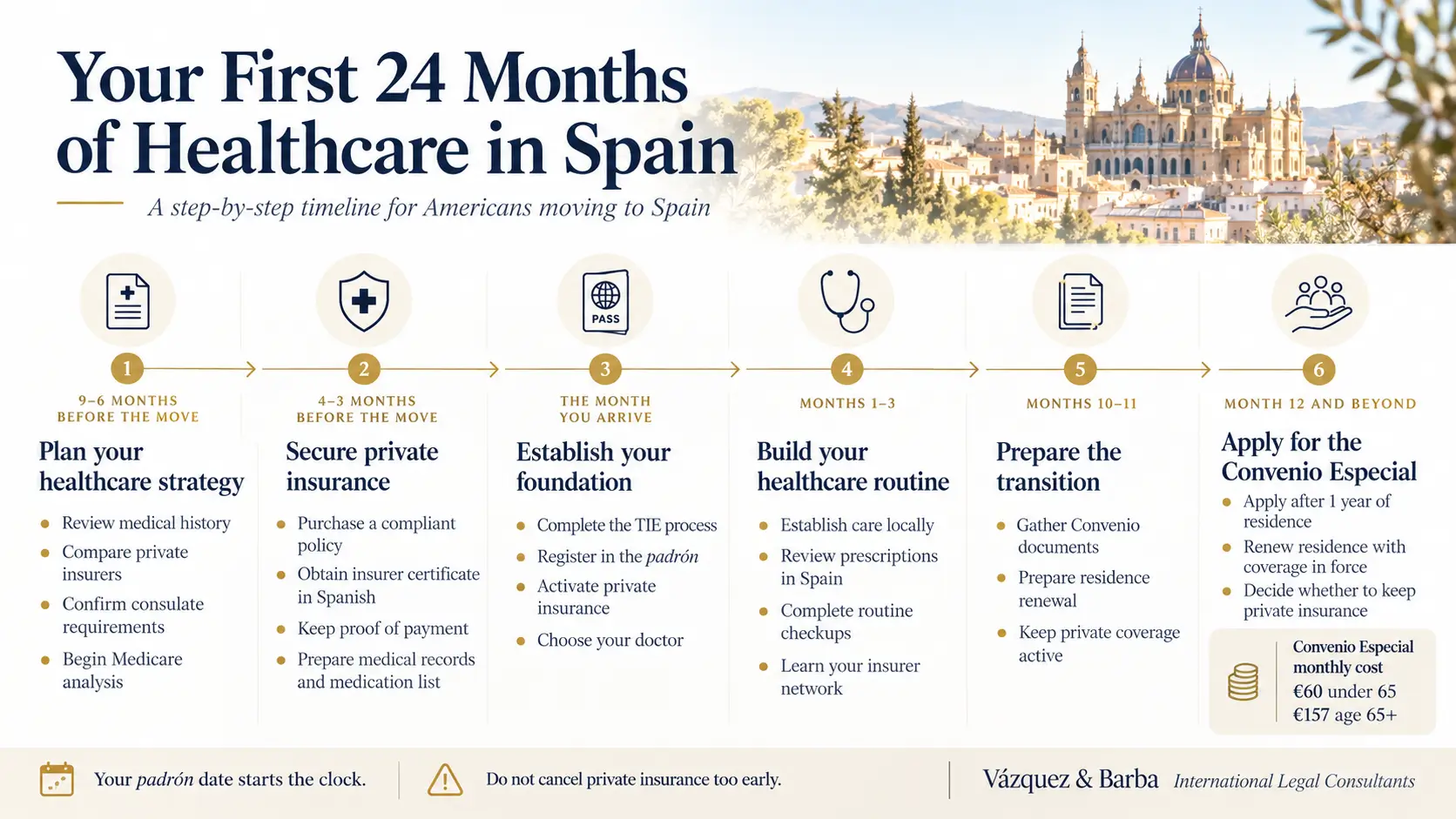
Part VI: A Month by Month Timeline
The following sequence reflects how we plan healthcare for American families moving to Spain on a Non-Lucrative Visa.
Nine to six months before the move
Review your medical history with an eye to underwriting, including any conditions an insurer may exclude. Consider healthcare access when choosing your region and neighborhood; proximity to a major hospital matters more at seventy than at fifty. Begin your Medicare analysis. Request comparative quotes from insurers authorized in Spain, and confirm the current requirements of your consulate.
Four to three months before the move
Purchase the policy that meets the consulate’s requirements, obtain the insurer’s certificate in Spanish, and keep proof of payment. Arrange the separate medical certificate required for the visa application, and prepare your translated medical records and medication list.
The month you arrive
Complete your foreigner identity card (TIE) process and register in the padrón as soon as you have an address. Activate your private insurance, familiarize yourself with its network of doctors and hospitals, and choose a primary care physician.
Months one to three
Establish care with your doctor, have your ongoing medications reviewed and prescribed locally, and complete any routine checkups while your coverage is fully active.
Months ten and eleven
Gather the documents for your Convenio Especial application and prepare the renewal of your residence authorization. Confirm that your private policy will remain in force throughout the renewal process.
Month twelve and beyond
Apply for the Convenio Especial once you meet the one year requirement, file your residence renewal with your private coverage in force, and maintain that coverage until the Convenio is active and the renewal is resolved. Then decide, with full information, whether to keep a private policy alongside the public system.
Part VII: The Mistakes We See Most Often
Most of the healthcare problems we are asked to solve fall into a small number of patterns.
The first is buying travel insurance for the visa application, which consulates do not accept for residence purposes. The second is choosing a policy with copayments or waiting periods to save on the premium, which leads to the file being returned. The third is registering in the padrón weeks or months after arrival, which delays eligibility for the Convenio by the same period. The fourth is cancelling private coverage before the Convenio is active and the residence renewal is resolved. The fifth is forgetting that the Convenio does not include prescription medications, and therefore underestimating the monthly cost of care. The sixth is assuming Medicare will work in Spain, or dropping Part B without understanding the lifetime penalty. The seventh is completing the insurer’s health questionnaire incompletely. The eighth is choosing a home without considering how far it is from the hospital care you may need in ten or fifteen years.
Each of these mistakes is avoidable. Each one becomes expensive only when nobody points it out in time.
This is the difference between hoping it works out and knowing exactly what to expect. It is also why we plan healthcare with every client from the first conversation, alongside residency, tax, and property, rather than treating it as a separate task to be solved after arrival. To map your own healthcare timeline, write to us at info@vbilc.com.
Private Sessions and Your Next Step
In the first half of October, our founding partners, Adriana María Barba and Manuel Vázquez Utzet, hosted private, invitation only sessions in Bogotá, Miami, and Washington, D.C. for families evaluating residency, property, and tax planning in Europe. Those sessions were reserved for a small number of families by design, and we are grateful to everyone who joined us.
Future private sessions are announced first to the families on our priority invitation list, before any public announcement.
Priority Invitation List. Places at our private sessions are limited and offered by invitation. Families on the priority list are the first to receive dates, cities, and invitation details for the next series.
How to join the priority invitation list
To be considered for our next private sessions, write to info@vbilc.com with the subject line “Priority Invitation List” and include the following information:
- The full names of the people who would attend.
- Your city and country of residence.
- What you are considering: residency, healthcare and relocation planning, a property purchase, tax planning, or a combination.
- Your approximate timeline.
- A telephone number where our team can reach you.
Our team reviews every request personally and replies by email.
Prefer to speak sooner?
Private virtual consultations are available with our team. Write to info@vbilc.com with the subject line “Virtual Consultation Request”, and we will reply to arrange a time.
Frequently Asked Questions
Can Americans use Spain's public healthcare system?
Yes, depending on the residence pathway. People who work in Spain and contribute to Spanish Social Security generally gain access through that affiliation. Non-Lucrative Visa holders begin with private insurance and can apply for the Convenio Especial after at least one year of continuous residence. Receiving US Social Security benefits does not, by itself, create a right to Spanish public healthcare.
Is travel insurance valid for the Non-Lucrative Visa?
No. Consulates require comprehensive health insurance, generally from an insurer authorized to operate in Spain, with no copayments and no waiting periods, valid for the full authorization period. Travel insurance does not meet these requirements.
How much does the Convenio Especial cost?
The monthly contribution is 60 euros for subscribers under 65 and 157 euros for subscribers aged 65 or older, according to Spain’s Ministry of Health. Each spouse subscribes individually.
Does the Convenio Especial cover prescription medications?
No. The Convenio covers the common basic portfolio of public healthcare services, but not the pharmaceutical benefit. Prescription medications are paid in full at the pharmacy, so they should be included in your monthly budget.
Should I keep Medicare Part B while living in Spain?
It depends on how often you expect to be in the United States, whether you might return for major treatment, and your age, health, and budget. Medicare generally does not pay for care in Spain, but dropping Part B can trigger a permanent late enrollment penalty of 10 percent for each full twelve month period without coverage if you re-enroll later. The decision deserves careful analysis before you leave.
Are pre-existing conditions covered by private insurance in Spain?
It depends on the insurer and the condition. Private insurers underwrite their policies, and pre-existing conditions may be excluded or may lead to a declined application. The Convenio Especial, as a public agreement, does not apply the medical underwriting that private insurers use.
Will my doctors speak English?
Many doctors in Spain’s major cities, and particularly in the private sector, speak English well. In the public system, English proficiency varies by region and by professional. Private insurers can often direct you to English speaking specialists, and we help clients identify them during the first months after arrival.
Does my Spanish coverage work when I travel in Europe?
The Convenio Especial provides coverage during temporary stays in other countries of the European Union and the European Economic Area, the United Kingdom, and Switzerland, through a provisional replacement certificate issued by Spain’s National Social Security Institute. Private policies vary, and many include travel assistance; review the terms of your own policy before you travel.
A Plan, Not a Surprise
Spain offers some of the finest healthcare in the world. The families who enjoy it without disruption are not the ones with the most resources. They are the ones who planned the transition as carefully as the move itself: the right policy for the consulate, an early padrón registration, a realistic budget for medications, a considered decision about Medicare, and private coverage that stays in place until the public system is fully active.
That plan takes a few conversations to build and protects your family for years. We would be glad to build it with you, as part of the same engagement that handles your residency, your taxes, and your property.
Sources
- TIME, reporting Bloomberg, “Spain Tops Italy as World’s Healthiest Country While U.S. Falls” (February 24, 2019): https://time.com/5536174/spain-healthiest-country/
- Newsweek, “World’s Best Hospitals 2026: Spain”: https://rankings.newsweek.com/worlds-best-hospitals-2026/spain
- Euronews, “Un nuevo récord: más de 853.000 personas esperan una operación en España” (April 16, 2026): https://es.euronews.com/salud/2026/04/16/un-nuevo-record-mas-de-853000-personas-esperan-una-operacion-en-espana
- El Independiente, on the growth of private health insurance in Spain (February 26, 2024): https://www.elindependiente.com/economia/2024/02/26/aseguradoras-subidas-salud-avalancha-nuevos-clientes/amp/
- CNBC, “Retiring overseas? How Medicare may or may not fit into your plans” (August 8, 2019): https://www.cnbc.com/2019/08/08/retiring-overseas-how-medicare-may-or-may-not-fit-into-your-plans.html
- PBS NewsHour, on whether retired expats should keep Medicare: https://www.pbs.org/newshour/economy/retired-expats-question-remains-keep-medicare-coverage-not